
Let’s be honest for a second. Most vision boards look amazing… and then quietly collect dust. I’ve made those boards too—the pretty ones that felt inspiring for about three days before real life laughed and moved on. Sound familiar?
Your 2026 vision board doesn’t need more glitter or stock photos of yachts you secretly don’t even want. It needs clarity, intention, and a few smart upgrades that actually push you to act. I’ve tweaked my own boards over the years, messed them up plenty, and finally figured out what separates “cute collage” from “wow, this is actually working.”
So grab your coffee and let’s fix your board before 2026 starts judging you. Ready? 😏
1. One Clear Word for 2026
Starting your 2026 vision board with one clear guiding word gives your entire year direction. Instead of juggling ten different goals that compete for attention, a single word acts like a filter for every decision you make. I’ve tried both approaches, and trust me—one focused word always wins.
This works because your brain loves simplicity. A word like Momentum, Stability, or Expansion becomes a mental shortcut. When opportunities show up, you naturally ask, “Does this support my word?” If the answer is no, you skip it without guilt. That alone saves energy and time.
Choosing your word feels easier than it sounds. Ask yourself what emotion, lifestyle, or mindset you want more of in 2026—and what you’re done tolerating. The right word usually clicks instantly. Place it boldly at the center of your vision board. No overthinking required. IMO, this step quietly sets the tone for everything that follows.
2. A Photo That Represents Your Ideal Daily Life
A photo that represents your ideal daily life matters more than any luxury image because your brain rehearses what it sees most often. Mansions and supercars look exciting, but they don’t shape your everyday behavior. Your 2026 vision board should reflect how you want an average day to feel, not a once-a-year vacation moment.
Choose images that show a cozy workspace, a slow, calm morning, or you feeling confident while doing normal tasks. These visuals train your mind to expect ease, focus, and consistency. Over time, your actions start matching that expectation without forcing motivation.
When I replaced flashy success photos with a simple image of someone working calmly with coffee, my stress dropped noticeably. I stopped chasing pressure and started building rhythm. That’s the real win. Daily life creates results, not highlight reels. Ask yourself this: if you lived this day on repeat, would you feel proud? If yes, that image belongs on your board.
3. A Financial Goal You Can Measure
A financial goal only works when you can clearly measure it. Saying you want “more money” sounds nice, but your brain doesn’t know what to do with that. It creates motivation for a moment, then fades. Specific numbers give your mind a target, and targets change behavior.
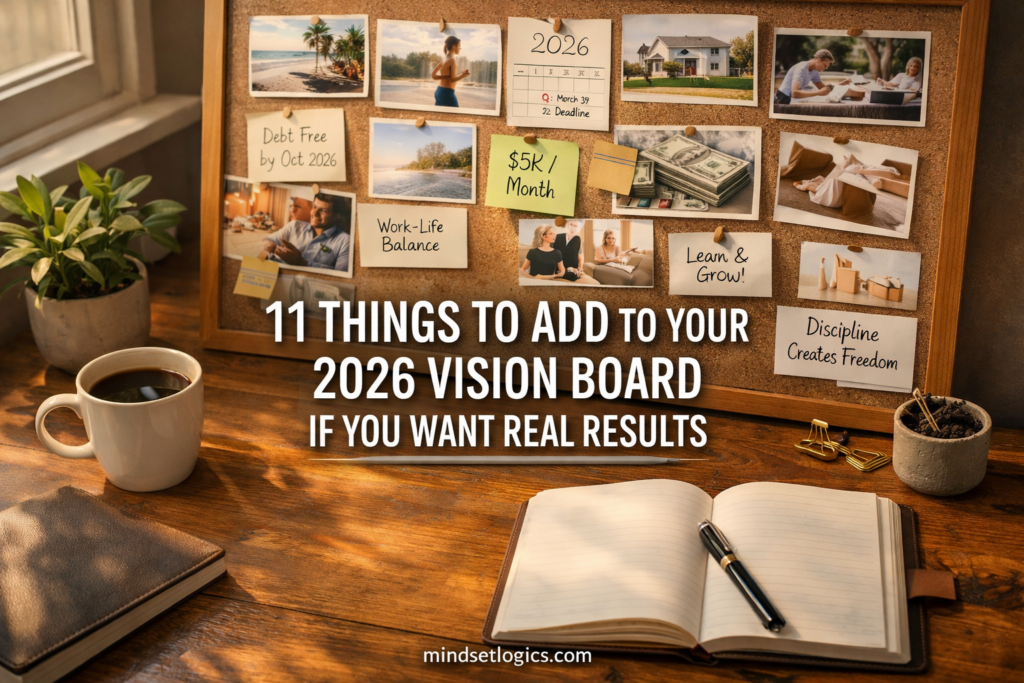
When you add clear figures to your vision board—like $5,000 per month consistently, debt-free by October 2026, or a $20,000 emergency fund—you turn a wish into a plan. You start making different decisions without forcing yourself. You track progress. You adjust when something isn’t working.
I’ve noticed that vague goals rely on mood, while numbered goals rely on structure. And structure always wins. When you know exactly what you’re aiming for, your actions align naturally over time. FYI, motivation comes and goes, but clarity stays—and that’s what actually moves your finances forward.
Stop manifesting money the hard way—read this first. 7 Money Manifest Secrets No One Tells You (Most People Do It Wrong)
4. One Habit You Commit to Mastering
Big goals don’t fail because you lack motivation—they fail because daily actions don’t support them. That’s why your 2026 vision board should include one habit you fully commit to mastering. Not five. Not a long checklist. Just one habit that moves the needle.
When you focus on a single habit, you give it space to stick. Daily 10-minute planning creates clarity and reduces stress. Weekly content creation builds momentum and long-term visibility. Morning movement boosts energy and discipline for the rest of the day. Each habit compounds quietly, but the results add up fast.
I’ve tried stacking multiple habits before, and it backfired. I felt busy, overwhelmed, and inconsistent. Once I chose one habit and protected it, progress finally felt real. The key question isn’t what sounds impressive—it’s which habit naturally supports the life you want in 2026. Choose that, and commit fully.
5. A “Before vs After” Version of You
A “Before vs After” version of you is one of the most powerful elements you can add to your 2026 vision board because it makes change feel real, not abstract. On the left side, show how life feels right now—your current habits, energy level, mindset, or challenges. This isn’t about self-criticism; it’s about honesty. You need to see where you’re starting from.
On the right side, show how you want to show up in 2026. Focus on confidence, clarity, discipline, and the lifestyle you’re building. Use images or words that reflect how you think, act, and carry yourself.
This side-by-side contrast creates an emotional gap your brain wants to close. When motivation drops or excuses show up, this visual reminds you why staying consistent matters. Instead of forcing motivation, you let identity drive action, which keeps you moving forward naturally.
6. A Quote That Triggers Action (Not Comfort)
A quote that triggers action matters more than one that feels comforting. Comforting quotes calm you, but they rarely push you to change anything. They make you feel okay staying exactly where you are. Action-triggering quotes do the opposite—they create a slight mental discomfort that pushes you to move.
That’s why you should skip fluffy, feel-good lines that sound nice but change nothing. Instead, choose quotes that challenge your excuses and demand responsibility. Lines like “Discipline creates freedom” or “No one is coming. Do it anyway.” work because they remove external validation. They remind you that progress depends on your daily actions, not motivation or luck.
When you see such a quote every day on your 2026 vision board, it acts like a quiet accountability partner. It nudges you to take action even when you feel lazy, tired, or unsure. If a quote doesn’t make you pause or rethink your behavior, it doesn’t deserve space on your board.
7. A Visual for Health You Actually Want
Most health goals fail because they feel like punishment. When your vision board shows extreme workouts or six-pack abs you don’t even enjoy chasing, your brain quietly checks out. Motivation drops fast when health looks like suffering instead of support.
A better approach focuses on lifestyle, not struggle. Add visuals that represent how you want to feel every day. Think strong posture, steady energy from morning to night, and confident body language when you walk into a room. These images feel achievable and inviting, which makes consistency easier.
I learned this the hard way. I used to add ripped-body photos and feel inspired for a week—then exhausted just looking at them. When I switched to visualizing energy, calm strength, and confidence, my habits finally stuck. Ask yourself this: do you want to look healthy for photos, or actually feel healthy all day?
8. One Skill You’ll Improve in 2026
One Skill You’ll Improve in 2026 can quietly become the most powerful part of your vision board. Motivation comes and goes, but skills stick. When you invest in a skill, every small effort stacks over time, even on days when you don’t feel inspired. That’s why skills compound faster than motivation ever could.
Pick one core skill that directly supports your goals. If you want more income, focus on sales or negotiation. If you want visibility or influence, choose communication or content creation. The key is alignment, not variety.
On your 2026 vision board, don’t just write the skill name. Add a visual or short phrase that reflects the version of you who has already mastered it—confident, calm, and capable. This keeps your focus on identity growth, not just outcomes. When you grow the skill, the results follow naturally.
9. A Boundary You Refuse to Break
A boundary you refuse to break is one of the most powerful additions to your 2026 vision board because it protects your energy, not just your time. Goals fall apart when life feels overwhelming, and boundaries prevent that slow burnout before it starts. When you clearly define rules like no working past 9 PM, saying no without guilt, or protecting your weekends, you stop letting other people’s priorities control your schedule.
Adding a boundary to your vision board turns it into a visible commitment, not just a mental note. Every time you see it, your brain registers that your time and well-being matter. Over time, this builds self-trust. You start showing up more focused, rested, and consistent.
Most people fail not because they lack motivation, but because they break promises to themselves. A strong boundary quietly fixes that problem by reminding you what you will no longer tolerate.
10. A Reminder of Why You Started
A reminder of why you started keeps your goals emotionally grounded. When progress slows or pressure builds, it’s easy to forget the deeper reason behind your effort. That’s when goals start feeling heavy instead of meaningful. A simple visual reminder reconnects you to the purpose that made you begin in the first place.
The most effective reminders feel personal, not dramatic. A family photo can instantly remind you who you’re working for and what kind of future you want to build. A handwritten note adds emotional weight because it captures your mindset at the moment you committed to change. A short phrase like “Freedom over fear” works because it cuts through overthinking and brings clarity in seconds.
When burnout shows up, this reminder acts like an emotional reset. It quietly realigns your focus without forcing motivation. You don’t need a pep talk—you just need to remember why this matters.
11. A Timeline Anchor (Yes, Deadlines Matter)
A timeline anchor turns vague goals into something your brain can’t ignore. Dreams feel exciting, but without time attached, they stay in “someday” mode. Deadlines force decisions, action, and accountability. That’s why this element matters so much on your 2026 vision board.
To add a timeline anchor, keep it simple. Include specific months, clear quarters, or one bold deadline that represents a major milestone. For example, instead of thinking “I’ll grow my income,” write “$5K/month by June 2026.” Suddenly, the goal feels real and urgent.
When I added timelines to my own board, procrastination didn’t stand a chance. I stopped delaying and started adjusting my daily actions to match the clock. Ever notice how your focus sharpens when a deadline exists? That’s exactly what a timeline anchor does—it pulls your vision out of imagination and into execution.
Conclusion
A 2026 vision board works when it feels personal, practical, and a little uncomfortable—in the right way. You don’t need perfection. You need clarity, consistency, and visuals that push you to act on bad days, not just hype you on good ones.
If your board only makes you feel inspired, it’s incomplete. If it makes you pause, rethink habits, and show up differently, you nailed it. So take another look at your board today. Remove the fluff. Add intention. And make 2026 the year your goals stop hiding behind aesthetics and start turning real.
Now tell me—what’s the first thing you’re adding?