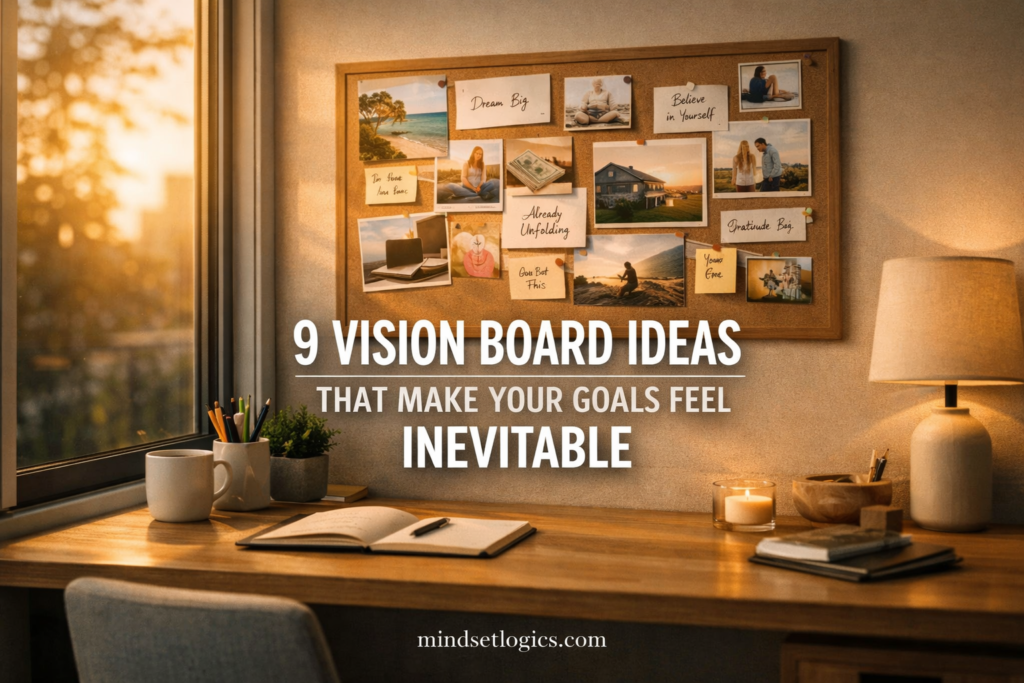

Let me guess—you’ve made a vision board before, felt super motivated for about three days, and then… life happened. Same here. I used to think vision boards worked only for ultra-positive people who wake up at 5 a.m. smiling. Turns out, I was just doing it wrong.
A good vision board doesn’t just look pretty. It makes your goals feel so real that your brain starts treating them like a done deal. That shift changes how you think, decide, and act—without forcing fake positivity.
In this article, I’ll walk you through 9 vision board ideas that make your goals feel inevitable, not wishful. I’ll share what actually worked for me, what failed hard, and why some boards quietly rewire your mindset while others collect dust. Ready to build something that sticks? Let’s go.
1. Outcome-Based Vision Board (The “End Result” Board)
An Outcome-Based Vision Board, also called the “End Result” board, focuses on what your goal looks like after it’s already achieved. Instead of filling your board with random luxury items or vague motivation quotes, you choose visuals that clearly represent the finished result you want to experience. Think of it as showing your brain the final scene, not the messy middle.
This approach works because your brain responds best to clarity. When you give it a clear picture of success, it starts treating that outcome as real and reachable. You may notice you become more alert to opportunities, ideas, and decisions that move you closer to that result—without forcing yourself to stay motivated all the time.
To create this board the right way, use images that show completion, not effort. For example, a “loan paid” screen instead of someone working late, or a published book cover instead of someone typing. Add short, direct captions like “Paid off,” “Published,” or “Living here” to lock the message in. Keep the board focused with 10 to 15 strong visuals. Too many images dilute the impact.
Clear goals feel urgent because your brain knows where it’s going. Vague goals feel optional because your brain can’t grab onto them. That’s psychology—not luck.
Feeling stuck or unsure where to start? These steps break it down clearly. 7 Proven Steps That Show You Exactly How to Take Control of Your Goals
2. Identity-Based Vision Board (Become the Person First)
An identity-based vision board flips the usual goal-setting approach on its head—and honestly, that’s why it works so well. Instead of obsessing over what you want to achieve, this board focuses on who you need to become to achieve it. IMO, this shift changes everything because goals stop feeling forced and start feeling natural.
This type of vision board highlights habits, traits, and daily behaviors, not flashy outcomes. You’re not visualizing a six-figure bank balance or a perfect body. You’re visualizing the person who naturally creates those results. Think confidence, discipline, calm focus, and consistency. These qualities drive long-term success far more than motivation ever will.
For example, you might include an image of someone journaling every morning, representing self-awareness and clarity. Another image could show a relaxed person managing finances wisely, signaling emotional control around money. A fit person sticking to routines—even on low-energy days—reinforces consistency over hype.
When you repeatedly see yourself as this upgraded version, your brain starts aligning your choices with that identity. You don’t push yourself—you act in character. And once your identity shifts, achieving the goal feels inevitable, not exhausting.
3. Timeline Vision Board (Past → Present → Future)
A Timeline Vision Board works because it turns your goals into a story instead of a wish list. And honestly, our brains love stories way more than random motivation quotes. When I use this method, I stop feeling like I’m “chasing” something and start feeling like I’m simply continuing a journey.
Here’s how it works. I divide my vision board into three clear sections: past, present, and future. The past section shows where I started. This might include struggles, early efforts, or situations I’ve already outgrown. I don’t use this part to feel bad—I use it to build perspective.
The present section focuses on what I’m working on right now. These images represent habits, routines, and small actions I’m actively taking. This keeps me grounded instead of overwhelmed.
The future section shows where I’m going. These visuals feel realistic, not dramatic. They represent outcomes that look like a natural next step, not a fantasy life.
This board feels powerful because it removes pressure. Goals stop feeling distant or unrealistic. They feel inevitable, like the next chapter in a book that’s already in progress. FYI, on hard days, this board hits different. It reminds you how far you’ve come—and that alone can restart momentum.
4. Emotion-Focused Vision Board (Feel It Before You Have It)
An Emotion-Focused Vision Board flips the usual approach on its head. Instead of chasing specific goals like a car, a house, or a bank balance, you focus on the feelings you want to live with every day. When I first tried this, I honestly didn’t expect much. But it ended up being one of the most powerful shifts I made.
Think about emotions like peace, freedom, pride, and security. These aren’t random. They’re the real reasons behind most goals. You don’t want money just to see numbers in an account—you want relief from stress, freedom to choose, and the calm that comes with stability. Once you see that, everything clicks.
To build this kind of vision board, choose images that make you feel something immediately. A calm morning scene, someone exhaling in relief, a confident posture—stuff that hits emotionally, not logically. Add simple words like “calm,” “relief,” or “confidence” to anchor those feelings in your mind. Skip flashy material images unless they genuinely trigger emotion.
This works because your brain responds faster to feelings than facts. When you repeatedly experience the emotions visually, your mind starts treating them as familiar—and familiarity makes them feel achievable.
5. Micro-Goal Vision Board (Small Wins, Big Belief)
Big goals sound exciting, but let’s be honest—they can also freeze you in place. When your brain sees a huge goal, it often thinks, “That’s a lot… maybe later.” A micro-goal vision board flips that reaction. Instead of focusing on the finish line, it highlights small, doable wins that move you forward.
This board includes first steps, not final outcomes. Think actions you can start today, not someday. When you visually remind yourself that progress already happens, your brain relaxes and cooperates. Confidence grows faster when your mind sees proof instead of pressure.
For example, “First $1,000 saved” feels realistic compared to “financial freedom.” “10 workouts completed” feels achievable compared to “perfect body.” “Website launched” feels possible compared to “six-figure business.” Each small win builds belief, and belief fuels consistency.
The real power of this board comes from momentum. Every time you complete a micro-goal, your brain collects evidence that you follow through. Over time, those small wins stack up and make bigger goals feel natural instead of scary.
Small progress isn’t small thinking—it’s smart strategy.
6. Anti-Goal Vision Board (What You’re Done With)
An anti-goal vision board flips the usual approach on its head. Instead of focusing on what you want to achieve, you focus on what you are no longer willing to tolerate. Yes, it sounds a little backward. It also works shockingly well.
On this type of board, you include images that represent stress, burnout, financial pressure, unhealthy routines, or emotional chaos—basically, the situations you’re done repeating. Add strong, clear words like “No more,” “Never again,” or “I’m done settling.” These visuals act as firm reminders of the life you’re actively choosing to leave behind.
This method works because pain is a faster motivator than pleasure. When your brain clearly remembers how bad something felt, it pushes you to move forward even on low-motivation days. Pleasure can feel optional. Pain feels urgent.
I’ve noticed this board works best when discipline starts slipping. One glance, and your mind remembers why quitting isn’t an option. It turns discomfort into fuel.
Ask yourself this honestly: what version of your life are you officially done tolerating? Once you answer that, forward momentum becomes much easier to maintain.
7. Environment-Based Vision Board (Design Your Surroundings)
An environment-based vision board focuses on the spaces you live and work in, not just the goals you want to reach. This works because your environment quietly controls your behavior, often more than motivation or willpower ever could. You don’t rise to your goals—you fall to the systems and surroundings around you.
Instead of visualizing outcomes like money or success, this type of vision board helps you picture how your daily environment supports the person you want to become. That includes your ideal workspace, your morning routine setup, and the overall energy of your home. Think clean desk, natural light, intentional layouts, and calm, focused vibes. These visuals train your brain to see this environment as normal and expected.
I personally place this board right where I work every day. I don’t use it for motivation; I use it as a reminder. When I see it, I naturally start acting like the future version of myself—sitting better, focusing longer, and making smarter choices without forcing it.
When your surroundings match your goals, discipline stops feeling like a constant battle. Your environment does the heavy lifting for you. It may sound strange, but once you experience it, the effect feels obvious and effortless.
8. Proof-Based Vision Board (Evidence Over Inspiration)
This is one of the most underrated vision board ideas—and honestly, one of the most powerful. Instead of trying to feel inspired all the time, this board focuses on proof. Real, undeniable evidence that you already know how to win.
On this vision board, you collect things like screenshots of past achievements, positive messages from clients or friends, and milestones you’ve already hit. It could be a payment confirmation, a before-and-after result, or even a simple thank-you message. Nothing fancy. Just facts.
Why does this work so well? Because self-doubt collapses when faced with evidence. Motivation can fade, emotions can fluctuate, but proof stays solid. When your mind starts whispering, “What if I can’t do this?”, this board answers back with, “You already did.”
Most people remember failures more clearly than successes. That’s just how the brain works. This vision board flips that bias. It trains your mind to focus on progress instead of problems. Over time, confidence stops feeling forced and starts feeling logical. And when confidence feels logical, your goals stop feeling optional.
9. “Inevitable Future” Vision Board (No Deadline, No Pressure)
The “Inevitable Future” vision board works because it removes the one thing that quietly sabotages most goals: pressure. Deadlines often create anxiety instead of motivation. You start watching the calendar instead of trusting the process, and that stress makes your goals feel fragile. This board does the opposite. It replaces urgency with certainty.
Instead of adding dates or timelines, you focus on the assumption that your future is already in motion. Phrases like “Already unfolding” or “This is happening naturally” signal safety to your brain. When your mind feels safe, it stops resisting and starts cooperating. That’s where consistency comes from.
The images on this board matter too. Skip the flashy, over-the-top visuals. Choose pictures that feel normal, grounded, and realistic—the kind that make you think, “Yeah, this makes sense for me.” That familiarity makes your goals feel reachable instead of intimidating.
The overall vibe stays calm and relaxed. No hustle energy. No countdown clocks. Just quiet confidence. This board doesn’t scream motivation; it whispers belief. And strangely enough, that whisper often feels more convincing than loud affirmations ever could.
When your future feels inevitable, effort becomes natural—and quitting stops feeling like an option.
Conclusion
A vision board shouldn’t feel like a motivational poster you ignore after a week. It should quietly reprogram how you see yourself and your future. The best boards don’t beg the universe—they train your brain.
You don’t need all nine ideas. Pick one or two that click with you right now. Build them honestly. Look at them daily. Adjust them without guilt. Progress loves flexibility.
So here’s my question for you—which version of your future already feels inevitable? Start there. Your brain will do the rest.